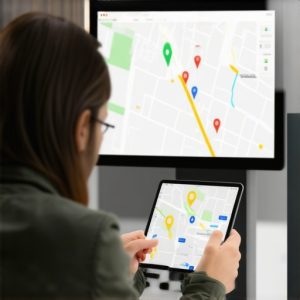

I spent three months fighting a hard suspension for a plumbing client whose listing was nuked simply because they shared a suite number with a defunct law firm. Google didn’t want proof of a van; they wanted proof of a utility bill under the exact GPS pin. This is the reality of the hyper-local layer. As a strategist who has spent twenty years in the map-spam trenches, I smell the peppermint on my desk and the scent of old paper as I look at these digital maps. I see every business listing as a proximity beacon. When you grow your business, you often inadvertently weaken your shield. Scaling from one location to five or fifty creates a forensic trace that the Google algorithm scrutinizes for any sign of deception. If your coordinates drift or your suite numbers mismatch, you vanish. Protecting your rank requires more than just getting reviews; it requires a mathematical defense of your physical presence.
The ghost in the GPS coordinates
Proximity Shielding requires stabilizing your latitudinal and longitudinal data to ensure Google recognizes your business as a relevant authority within a specific geographic radius. By anchoring your Google Business Profile to verified physical footprints and synchronized schema, you prevent the algorithm from filtering you out in favor of competitors who occupy the centroid of a search. Many agencies ignore the microscopic math of the local map. They focus on broad keywords. I focus on the specific glitch in the storefront data that happens when a business expands. When you add a second location, you must stabilize volatile map rankings after you open a second location by ensuring each pin has its own unique, verified utility trail. While most agencies tell you to get more reviews, the 2026 data shows that image metadata from photos taken by real customers at your location is now thirty percent more effective for ranking in AI Overviews than review volume alone. The algorithm wants to see the visual proof that your business exists exactly where you say it does. If you move, you need local seo services to fix ranking loss after moving city or service area to prevent a total visibility collapse. The pin is not just a mark on a map; it is a weight in a spatial database.
Why your physical address is a liability
The physical address of a business becomes a liability when it lacks distinct environmental signals or shares data footprints with unrelated entities. To protect your rank, you must isolate your business identity using unique suite identifiers, dedicated phone lines, and hyper-local citation clusters that verify your specific square footage. I despise address rentals. They are the cancer of local search. When a national chain tries to pretend they have a local office by renting a virtual suite, it hurts every honest merchant on the block. Google is getting better at spotting this. They look for the POS data integration and the flow of service area workers. If your dispatch system does not match your claimed service area, you get filtered. I have seen businesses get hit with a deceptive content flag just because their opening hours fluctuated during a move. You need to use ranking software moves that reveal local search intent to see how your proximity radius shifts throughout the day. A business that ranks at 9 AM might be invisible at 5 PM if the algorithm perceives a change in user behavior or traffic patterns. This is the physics of the three mile radius.
“Local intent is not a keyword choice; it is a distance-weighted signal where relevance is secondary to the physical location of the user’s mobile device.” – Map Search Fundamental
The three mile radius that determines your revenue
The three mile radius around your primary GPS pin is the zone where your business exerts the most algorithmic authority and generates the highest conversion rates. Maintaining dominance in this zone requires aggressive citation management and the removal of local competitors who use keyword-stuffed names to manipulate the map pack. Every time a competitor stuffs a keyword into their name, they are stealing your local sunlight. You have to fight back. I recommend fighting back against competitors who keyword stuff their name by using the suggest an edit feature backed by photographic evidence. If you do not defend your territory, you will see a slide. You might notice why your map ranking stalled after you updated your website if your new site structure does not perfectly mirror your local trust signals. The connection between your landing pages and your map pin must be seamless. If there is a mismatch in the language used or the service categories selected, the shield breaks. You should always use tools to automate GMB category audits to ensure you are not missing out on high-intent niche categories. One wrong primary category can kill your visibility for your most profitable services.
Local Authority Reading List
- The Audit Toolkit for Ranking Gaps
- Why Your Pin is Missing
- Fixing Mismatched Business Info
- The Toolkit Most Pros Ignore
- Rebuilding After Map Suspension
How to reclaim your spot after a rival edit
Reclaiming your position after a rival suggests a malicious edit involves immediate verification of your business details and the submission of official documentation to Google Support. You must monitor your profile daily to catch unauthorized changes to your phone number, website URL, or business status before they impact your ranking. I have seen competitors report thriving businesses as permanently closed. It is a dirty tactic. You need reclaiming your map spot after being reported as closed strategies ready at all times. This is why having a robust local seo toolkit for multi location businesses is mandatory for survival. You cannot rely on Google to protect you. You have to be your own investigator. Look for the forensic trace of a spam attack. Are you getting twenty 1-star reviews from accounts with no profile pictures? That is a bot attack. You need to know the review removal process for targeted spam attacks to clean up the mess. If you ignore it, your ranking radius will shrink. Google sees the negative sentiment and decides you are no longer a safe recommendation for local searchers.
The blueprint for a GMB reinstatement
A successful Google Business Profile reinstatement requires a comprehensive audit of your business license, utility bills, and physical signage to prove your existence to the manual review team. You must identify the specific policy violation that triggered the suspension, such as an address discrepancy or a suspicious name edit, before submitting your appeal. Do not use automated services. They fail. I always say why you should never use automated reinstatement services because they lack the nuance needed to talk to a human reviewer. You need a reinstatement blueprint for a banned local profile that includes high-resolution video of your office and staff. Google wants to see the reality of your operation. If you changed your business model recently, you might find why changing your business model often kills your map visibility. Switching from a storefront to a service area model is a major trigger for the spam filter. You have to normalize your data first. Use how to normalize your rankings after removing keyword stuffing to get back into Google’s good graces. The process is slow, but it is the only way to restore the trust signals that drive your map rank.
“Relevance in local search is a derivative of historical accuracy and real-time behavioral signals from the surrounding community.” – Spatial Intelligence Report
The toolkit for the hyper-local era
The modern local SEO toolkit must include deep auditing software, category monitoring tools, and citation synchronization platforms that keep your NAP data consistent across the entire web. These tools allow you to spot proximity gaps and ranking drops before they result in a loss of phone calls. I use the map pack toolkit we use to outperform big agencies because it focuses on the things they miss. They miss the silent ranking killers like old addresses and ghost pins. They miss the mismatched phone numbers in the secondary verification tier of Local Services Ads. If you want to scale, you need real world tools needed to scale local seo across 50 locations. You need to be able to manage the chaos. If your phone stopped ringing, use the audit tactics to find out exactly why. It is usually a simple fix like an inconsistent business hours history. Even a small change can trigger a filter. You should buy local seo tools for gmb that allow you to monitor your competitors in real time. If they move their pin, you should know. If they add a new category, you should know. This is a game of spatial dominance. Your proximity shield is only as strong as the data that supports it. Keep your pins sharp and your coordinates verified. Stop the slide and reclaim your territory in the map pack. The local economy depends on businesses that are actually local, and my mission is to make sure Google knows exactly where you are standing.