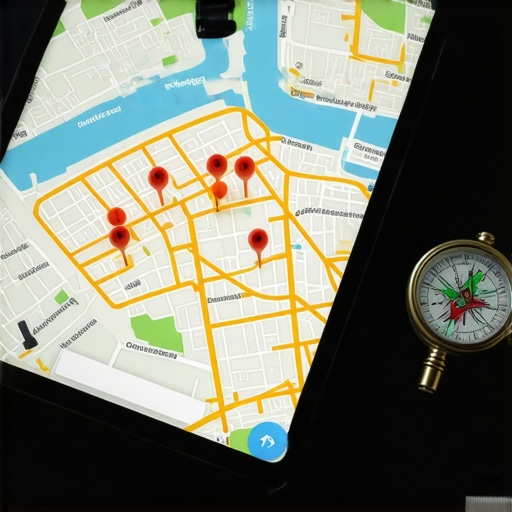
The ghost in the GPS coordinates
Local search tools fail because they treat proximity as a fixed point on a map instead of a fluid distance-weighted signal influenced by user behavior. Most national agencies look at a dashboard and see a green bubble, but they miss the spatial database reality where GPS coordinate salience and centroid bias determine if a business exists in the eyes of the Google algorithm. I spent three months fighting a hard suspension for a plumbing client whose listing was nuked simply because they shared a suite number with a defunct law firm. Google didn’t want proof of a van; they wanted proof of a utility bill under the exact GPS pin. That experience taught me that the Map Pack is not a marketing platform, it is a forensic record of physical presence. The smell of wet concrete after a storm reminds me of that summer, standing outside their office taking timestamped photos of a lobby directory just to prove they were real. The tools we use now are designed to prevent that kind of algorithmic erasure by mirroring the exact technical scrutiny Google applies to every local business.
The forensic truth of gmb vs local listing tools comparison
Specialized local SEO tools outperform general marketing suites because they focus on API-level data accuracy and location-specific indexing rather than just broad keyword tracking. When you download gmb ranking tools for local seo, you are looking for software that can visualize proximity glitches and centroid shifts that standard SEO crawlers completely ignore. I have seen countless businesses lose their rankings because their agency used a tool that didn’t account for the Vicinity algorithm. You need to understand how to spot a broken data sync before it destroys your local ranking. Big agencies love high-level reports. We prefer the grit of finding out why a specific street corner is a dead zone for your business. The difference lies in the granularity of the data and the ability to see through the filtered search results that Google uses to keep the Map Pack clean.
“Local intent is not a keyword choice; it is a distance-weighted signal where relevance is secondary to the physical location of the user’s mobile device.” – Map Search Fundamental
Local Authority Reading List
- The professional cleanup service for messy multi-location profiles
- Why the Google Business Profile algorithm ignores your structured citations
- The tools agencies use to automate GMB category audits
- How to get a suspended profile back without the support loop
- The trust restoration checklist for flagged local businesses
Technical seo services to fix indexing and crawling issues
Technical SEO for local maps requires a specialized focus on schema markup, NAP consistency, and the geometric relationship between your website and your physical Google Business Profile. If your city pages are not correctly mapped to your service area polygons, Google will view your presence as suspicious and filter you out of the top results. Many small business owners are searching for specific schema moves that force city pages into the map pack because they realize general content isn’t enough. The bots are looking for LocalBusiness JSON-LD that matches the CID (Cluster ID) of your profile. When these signals are mismatched, your ranking stalls. We use a toolkit that performs a deep audit move that reveals when citation sync is broken. This isn’t about keywords. It is about machine-readable trust. If the crawler can’t verify your coordinates against three independent high-authority sources, you are invisible. This is why we focus on fixing the exact reasons websites get stuck in the local filter. It is forensic work, not creative writing.
Why your physical address is a liability
Address salience has become the most dangerous metric in local search because Google now prioritizes unique physical storefronts over shared spaces or service area businesses without a clear anchor. If your address is flagged as a virtual office or a coworking space, you are one algorithm update away from a hard suspension. You must know the suite number mistake that keeps your map pin in the shadows. The algorithm uses spatial clustering to identify spam. If fifty businesses are registered to one suite, Google simply hides them all. We have developed google maps seo services for suspended profiles that specifically target these spatial red flags. Most agencies will tell you to just get more reviews. That is bad advice. If your NAP data is corrupted at the root, review velocity will not save you. You need to understand why review velocity fails to fix a broken map position. We look for the ghost office problem and scrub dead listings from the maps to clear the path for your real location.
“Relevance is the degree to which a business profile matches what someone is searching for, but proximity is the physical barrier that no amount of relevance can overcome.” – Local Search Guidelines
The three mile radius that determines your revenue
Proximity radius is the primary filter that determines who gets the phone calls and who gets buried on page two of the maps. Your search area is not a circle; it is a jagged polygon shaped by competitor density and local intent signals. We use ranking software to monitor local proximity gaps and identify exactly where your signal drops off. If you are a plumber, you don’t care if you rank twenty miles away. You care about the three-mile radius around your dispatch center. To expand this, you need neighborhood radius tactics that actually work. This involves geo-tagged images and local justification triggers that prove you are active in specific areas. While others pay for garbage citations, we focus on tripling map views without low-quality links. The goal is to create behavioral signals that tell Google your business is the most relevant choice for users in a specific, expanding geography.
Technical recovery for hacked or infected websites
Website security is a direct ranking factor for the Map Pack because a compromised site destroys the trust score of your local listing. If your site is redirected to a pharmacy or a gambling page, Google will disconnect your GMB profile within forty-eight hours. We offer services to repair hacked or infected websites for seo because we know that a single malicious script can kill years of local authority. You have to rebuild trust signals when Google flags your business as spam. This requires more than just a malware scan. It requires a clean data sync across all your local entities. A hacked site often leads to mixed language errors on your map profile. If you see this, follow the exact steps to fix mixed language errors. Your website is the primary source of truth for your local profile. If the truth is corrupted, the map listing will fall.
The hidden tool that uncovers competitor map spam
Map spam is the biggest threat to honest local businesses, and most agencies are too lazy to report it correctly. We use technical seo services to identify keyword-stuffed business names, fake addresses, and lead-gen sites that are clogging up your neighborhood. You need to use the hidden tool that uncovers competitor map spam to level the playing field. When you find a rival outranking you with zero reviews, it is usually because they are manipulating proximity filters. We analyze why competitors with zero reviews are outranking you and build a case to have their spammy listings removed. This isn’t just about reporting. It is about understanding the mathematical weight of their deceptive signals. Once you clear the spam, your legitimate listing will naturally rise. This is the rebuilding process after a spam-driven map mess. It takes time, but the ROI of a clean Map Pack is undeniable.