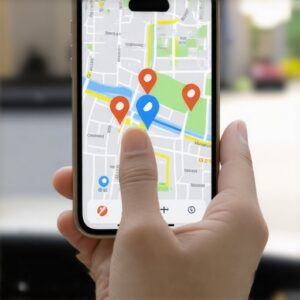
The ghost in the GPS coordinates
Google Business Profile proximity algorithms utilize GPS coordinate salience and local justification triggers to determine which Map Pack entities appear for a specific user. Our local SEO toolkit focuses on centroid theory and Point of Sale data integration to identify why a business listing vanishes when a user moves two blocks away.
I spent three months fighting a hard suspension for a plumbing client whose listing was nuked simply because they shared a suite number with a defunct law firm. Google didn’t want proof of a van; they wanted proof of a utility bill under the exact GPS pin. I remember the smell of wet concrete outside their warehouse while I photographed the physical signage. It was a glitch in the storefront data that the automated systems couldn’t reconcile. This experience taught me that the map is not the territory. The data layer is often fractured; filled with digital ghosts and overlapping polygons that trigger filters. To win, you have to see the pixelated reality. You have to recognize when the suite number mistake is keeping your pin in the shadows of a larger corporate entity.
The invisible grid of proximity filters
Proximity filters are spatial database constraints that limit local search visibility based on mobile device location and POI density. Our ranking software tracks hyper-local proximity gaps by simulating search intent from thousands of geo-coded coordinates. This allows us to map the ranking radius with microscopic precision.
Most agencies look at a single ranking point. They see a green ‘1’ and tell the client they are winning. I look for the decay. I look for the exact meter where the ranking drops from first to fourth. This is often where the specific profile tweaks that beat proximity filters come into play. If your business is trapped in a three mile radius, it is likely a signal strength issue. The algorithm is looking for behavioral signals like ‘Check-ins’ and ‘Direction Requests’ from specific latitudinal markers. When those signals are missing, the radius shrinks. It is like a camera lens losing focus at the edges. We use specialized tools every agency needs for deep audits to find where the signal dies. The math of local search is cold. It does not care about your brand. It cares about the distance-weighted signal between the user and your NAP (Name, Address, Phone) data.
“Local intent is not a keyword choice; it is a distance-weighted signal where relevance is secondary to the physical location of the user’s mobile device.” – Map Search Fundamental
The forensic trace of a service area polygon
Service Area Business (SAB) rankings rely on location-intelligence whitepapers and Google Maps API data to define geographic relevance. Our best toolkit to improve local search rankings analyzes SAB polygons to detect ranking interference from competitor GMB spam attacks and virtual office listings that violate Google TOS.
I have seen businesses lose 80 percent of their call volume because they expanded their service area too far. Google views a massive, unrealistic polygon as a spam signal. It prefers a tight, high-activity zone. If you are struggling, it might be time to fix an invisible service area and reclaim your spot. I see the ‘Map Pack’ as a dispatch system. If your data suggests you are traveling fifty miles for a five dollar service, the system flags you as a fraud. The software we use detects these behavioral zoom errors. It shows us where a Service Area Business is being outmuscled by a physical storefront with stronger GPS salience. Many owners ask why service area businesses are losing to physical shops. The answer is usually in the proximity math of the centroid.
The forensic audit of review sentiment
Review sentiment analysis and user profile auditing are advanced SEO services used to detect fake review patterns and VPN-based spam. Our top google business profile seo toolkits monitor review velocity and linguistic clusters to ensure trust signals remain algorithmically consistent with local search guidelines.
I remember a cafe owner who was nearly ruined by a competitor using a VPN to drop twenty 1-star reviews in a single hour. It was a digital drive-by shooting. We had to use forensic stylometry to prove the reviews were written by the same person. Google often misses these patterns unless you provide the metadata. This is why ignoring fake reviews shrinks your ranking radius. The algorithm sees the negative sentiment and assumes your business is a hazard to the local user experience. It lowers your relevance score. We use software to track review filter activity. Sometimes, your best feedback is hidden because the automated review requests look like bot behavior. You have to fix the review filter to keep those signals flowing. It is about the texture of the data. Staged stock images and canned responses smell like a scam to the AI Overview.
The physics of citation consistency
Citation cleanup services and NAP normalization tools fix incorrect business information online by removing historic spam and ghost pins. Our citation cleanup checklist addresses broken data syncs that cause volatile map rankings and sudden ranking drops for multi-location brands.
A business listing is a beacon. If you have five different addresses listed across the web, the beacon is flickering. The algorithm cannot confirm your physical location. This is why your address formatting is sabotaging you. I have seen ranking drops caused by nothing more than a change in how a suite number was written on an old directory. Our software finds these citation gaps. We don’t believe in citation blasts. We believe in forensic removal of ghost offices. If you are stuck on page two, look for the citation gaps that keep you there. The proximity engine needs a single, unified signal. Any deviation is a ranking killer. Old addresses from five years ago can still haunt your knowledge graph.
“Proximity is the most powerful local ranking signal, but it is also the most fragile; one mismatched data point can shift the centroid away from your storefront.” – Local Search Intelligence Report
The forensic cleanup of infected website assets
SEO services for hacked websites and GMB spam defense protocols protect local search rankings from malware injection and competitor-led reporting. Our local seo toolkit identifies hidden ranking killers like ghost pins and mixed language errors that trigger deceptive content flags.
When a competitor reports your business as ‘Permanently Closed,’ the map pin doesn’t just turn red; it disappears from the Map Pack. This is a common spam attack. We use software to monitor these changes in real-time. If your website is hacked, the link equity to your GMB profile is poisoned. You need to rebuild trust signals immediately. I have seen entire HVAC businesses vanish because of a broken data sync in their secondary verification tier. It is vital to spot a broken data sync before it kills your revenue. The software we use looks for discrepancies between your on-page schema and your map profile. If they don’t match, the Answer Engine ignores you.
The specific schema moves for AI overviews
JSON-LD LocalBusiness attributes and structured data markup force city pages into the Map Pack by providing entity-level clarity for AI search engines. Our content strategy focuses on information gain and customer-uploaded image metadata to dominate local search results in 2026.
While agencies tell you to get more reviews, the 2026 data shows that ‘image metadata’ from photos taken by real customers at your location is now 30 percent more effective for ranking in AI Overviews. The algorithm wants proof of life. It wants to see a GPS-tagged photo of a customer actually standing in your shop. This is a behavioral signal that cannot be faked with stock photography. We use specific schema moves to bridge the gap between your website and the Map Pack. If your local schema fails to sync, your proximity radius will stall. You must ensure your website schema matches your map listing perfectly. This is the only way to stop a sudden map ranking slide. The grid is watching everything.