
The Backlink Trap: Why Certain Links Can Actually Shrink Your Search Radius
In the high-stakes world of traditional organic SEO, the mantra has always been “more is better.” More content, more keywords, and, most importantly, more high-authority backlinks. For years, digital marketers have chased the elusive “DR 90” link like it was the Holy Grail. However, when we step into the specialized arena of the Google Local Map Pack, the rules of the game change fundamentally. In fact, they don’t just change – they often invert.
Welcome to the “Backlink Trap.” As a Local SEO strategist, I have seen dozens of businesses invest thousands of dollars into high-tier PR campaigns and “authority” link building, only to watch their Google Maps visibility contract. They expect their search radius to expand across the city; instead, it shrinks until they are only visible to users standing in their own parking lot. This phenomenon occurs because non-local or geographically irrelevant links can confuse Google’s proximity filters, signaling that your business is a “national entity” rather than a “local pillar.”
In Local SEO, relevance and proximity often trump raw authority. While a link from a major national news outlet might boost your organic rankings on page one, it can simultaneously trigger a “Neural Filter” that limits your Map Pack reach. Data consistently shows that a business located two miles away from a searcher can easily outrank a “stronger” site with ten times the backlink profile, simply due to proximity bias and local signal clarity. If you’ve been wondering why your business stays invisible for local searches despite having five-star reviews, you might be caught in the Backlink Trap.
II. The Proximity Paradox: Why “Authority” Isn’t Everything
To understand why your search radius might be shrinking, we have to look at how Google’s local algorithm actually functions. It relies on three primary pillars: Proximity, Relevance, and Prominence. In the organic search world, Prominence (often driven by backlinks) is the king. In the local world, Proximity is the dictator.
The “Proximity Paradox” is a research-backed concept suggesting that Google prioritizes user convenience above almost all other factors for mobile searches. When a user searches for “plumber near me” or “best coffee shop,” Google assumes that the user wants the most immediate solution. If your backlink profile is dominated by global websites, tech blogs from another continent, or generic “guest posts” that lack a geographic footprint, you are diluting your “local entity” signal. You are essentially telling Google, “I am a famous brand on the internet,” but failing to say, “I am the most relevant solution for this specific neighborhood.”
This is where google business profile seo becomes a balancing act. If you over-index on global prominence without establishing local relevance, Google’s algorithm may categorize you as a broad informational resource rather than a local service provider. This leads to a situation where you rank globally for keywords but disappear from the local map for the very people driving past your front door. For a deeper dive into this imbalance, read our guide on The Distance Trap: Why Being Closer to Customers Doesn’t Guarantee a Map Spot.
III. Identifying the “Backlink Trap”: Toxic vs. Non-Local Links
Not all “bad” links are created equal. To escape the trap, we must differentiate between Toxic Links and Misaligned Links. Both can damage your local rankings, but they do so in different ways.
Toxic Links and Negative SEO
Toxic links are the traditional “spam” links – link farms, PBNs (Private Blog Networks) with low-quality content, and automated comment spam. In the local space, these are often used in “Negative SEO Attacks.” I have consulted on cases documented in Google Support threads where a business was hit with 5,000 toxic links overnight. The result? A dramatic drop in Map Pack rankings as Google’s spam filters flagged the entire Google Business Profile (GBP) as untrustworthy.
Misaligned Links: The Silent Radius Killer
Misaligned links are more insidious. These are high-authority links that are technically “good” but geographically “wrong.” For example, if you are a dental practice in Chicago, a backlink from a high-traffic lifestyle blog in London or a tech review site in San Francisco provides authority, but zero local relevance. When these links make up the majority of your profile, Google struggles to pin your “entity” to a specific geographic coordinate. It begins to doubt your local footprint. This is precisely why boring niche citations often outperform high-authority general backlinks in the local ecosystem. A link from your local Little League website or the neighborhood Chamber of Commerce carries a “geo-signal” that a national news site simply cannot replicate.
IV. The Neural Filter & Search Radius Shrinkage
How does this work on a technical level? Google utilizes what SEOs call a “Neural Filter.” This is an AI-driven layer of the algorithm designed to prevent “over-optimization” and ensure result diversity. If your link profile suggests you are a massive national brand, but your GBP says you are a local plumber, Google detects a mismatch. To avoid “over-promoting” a business that might not actually be the best local fit, the algorithm may shrink your ranking radius.
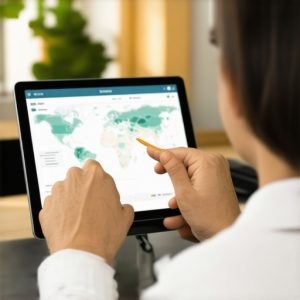
Instead of appearing in searches across a 10-mile radius, the Neural Filter might restrict your visibility to a 1-mile or even a 5-block radius. This is a defensive mechanism by Google to ensure that “hyper-local” businesses aren’t crowded out by “authority” brands that are actually located further away. You can use advanced local seo tools to visualize this shrinkage. When you look at a heat map of your rankings, you’ll see a “bullseye” effect: you rank #1 directly on your building, but the rankings drop to zero the moment you cross the street.
This phenomenon is becoming more aggressive as Google moves toward 2026. The algorithm is getting better at identifying “spatial search” patterns. If your digital footprint is too broad, the algorithm hides you from users who aren’t in your immediate vicinity. If you suspect this is happening to you, check out our analysis on Spatial Search Hiding You? 4 Google Local Pack Fixes [2026].
V. Hyper-Local Link Building: The Antidote
If you find yourself caught in the Backlink Trap, the solution isn’t to stop building links – it’s to change the *intent* of those links. You need to build a “Geographic Moat” around your business. This requires a shift from global authority to hyper-local relevance. The goal is to provide Google with undeniable proof that you are an integral part of your specific community.
Strategies for Expanding Your Radius:
- Local Sponsorships: Sponsoring a local 5k run, a high school football team, or a neighborhood festival often results in a link from a `.org` or `.edu` site that is geographically tied to your city. These are gold for local SEO.
- Neighborhood Blogs: Every major city has “hyper-local” news sites or neighborhood blogs. A mention or a guest post here provides a massive geo-signal that tells Google exactly where your service area lies.
- City-Specific Directories: Move beyond Yelp and Yellow Pages. Look for directories managed by your local city council or regional business associations.
The key to beating distance bias is “entity building.” By creating content that mentions local landmarks, neighborhood names, and local events, and then getting that content linked to by other local entities, you strengthen your proximity signal. If you find this process overwhelming, a professional google maps ranking service can help you identify these hyper-local opportunities and execute a strategy that expands your search radius rather than shrinking it. For more tactical advice, see The Hyper-Local Link Tactics That Actually Move Your Map Pin.
VI. Common Pitfalls: Audit Tools and Reporting Errors
One of the biggest challenges in identifying the Backlink Trap is that most traditional SEO tools are not built for Map Pack dynamics. Many audit tools focus on “Domain Authority” or “Toxic Link Scores” based on global metrics. They might tell you your backlink profile is “healthy” while your local rankings are actually cratering.
Research indicates a “40% Gap” in local reporting. Traditional audit tools often fail to capture up to 40% of real Google Map impressions because they do not account for hyper-local proximity shifts. They check rankings from a single data center or a general city-center coordinate, missing the fact that your visibility is shrinking at the neighborhood level. To get a true picture of your performance, you must use a dedicated google maps rank tracker that allows for grid-based tracking. This tool will show you exactly where your “ranking wall” is, allowing you to see the physical boundary where your visibility stops. Without this granular data, you are essentially flying blind. Don’t fall for the trap of vanity metrics; understand Why Your Rank Tracker Is Lying About Your Actual Map Position.
VII. Conclusion & Action Plan
The Backlink Trap is a sobering reminder that in the world of Google Business Profile SEO, quality and context always beat quantity. High-authority links from the other side of the country might look good on a report, but if they aren’t balanced with local signals, they can inadvertently signal to Google that you aren’t a “true” local provider, leading to a restricted search radius.
Your 3-Step Action Plan:
- Audit for Non-Local Authority: Review your backlink profile. If more than 70% of your links have no geographic connection to your service area, you are at risk.
- Build 5 Hyper-Local Citations: Focus on local charities, local business associations, or neighborhood-specific news sites this month.
- Monitor Radius Changes: Use a grid-based tracker to see if your visibility expands as you add local signals.
If you’re worried that your current SEO efforts are actually hurting your Map Pack performance, it’s time for a deep dive. Use a professional google business profile audit tool to diagnose your radius issues and start reclaiming your local territory. For more immediate help, check our guide on how to Fix Pack Ranking Issues Fast: Expert Troubleshooting Tips.