5 Local Tools That Reveal Why Your Business Is Missing From Search Results
You’ve done everything by the book. You claimed your Google Business Profile (GBP), uploaded high-resolution photos, and gathered a handful of glowing five-star reviews. Yet, when you search for your services from your home or a coffee shop just three miles away, your business is nowhere to be found. You aren’t in the “Local Pack” – that coveted top three spot on Google Maps – and your phone isn’t ringing.
As a Local SEO Consultant and Google Business Profile Product Expert, I see this “Invisible Business” crisis every day. It is a frustrating, silent killer of small businesses. Statistics show that roughly 92% of all online searches happen on Google, and a verified, well-optimized Google Business Profile averages about 200 clicks per month. If you aren’t seeing that kind of activity, something is fundamentally broken in your local search ecosystem.
Google doesn’t hide businesses on purpose. There is always a technical, algorithmic, or data-driven reason why you’ve vanished. Whether it’s a “ghost filter,” a proximity glitch, or a category mismatch, the answer is hidden in the data. To fix the problem, you need to stop guessing and start diagnosing. Here are the five essential tools I use to uncover why businesses are missing from search results and how to reclaim your visibility.
Before we dive into the tools, it is important to understand that even a “perfect” listing can fail. You might be wondering why your verified business listing isn’t showing up in the Local Pack, and usually, the answer lies in how Google perceives your authority relative to your physical location.
Tool #1: Heatmap Rank Trackers (The Proximity Reveal)
If you are using a traditional rank tracker that tells you “You are #3 for Plumber in Chicago,” I have some bad news for you: that tool is lying. Local search is not a flat environment; it is hyper-local and depends entirely on the searcher’s physical GPS coordinates.
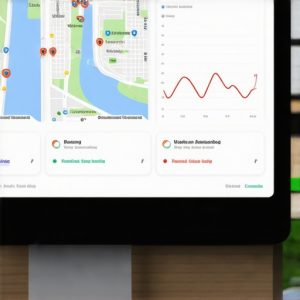
This is where heatmap rank trackers like SEO Viper Tools or Local Falcon become indispensable. Instead of giving you a single average ranking, these tools overlay a grid of “pins” across your city. Each pin represents a search performed at that specific coordinate. You might be #1 directly in your parking lot, but drop to #15 just two blocks away.
The Proximity Glitch and Spatial Search
The primary reason businesses disappear is the “Proximity Glitch.” Google’s algorithm prioritizes the distance between the searcher and the business. However, if your data is inconsistent or your “centroid” (the geographic center of your service area) is poorly defined, Google may apply a “Spatial Search” filter that hides you in favor of competitors who appear more relevant to that specific neighborhood.
By using a google maps ranking service like SEO Viper Tools, you can see the exact “border” where your visibility dies. If you see a sea of green (rankings 1-3) that suddenly turns into a wall of red (rankings 10+), you are likely being filtered out due to proximity or a lack of local relevance signals in those specific zones. This is the first step in understanding why your rank tracker is lying about your actual map position.
Tool #2: Technical GBP Audit Software
Once you’ve identified where you are missing, you need to find out why. Technical audit software, such as BrightLocal or Paige AI, performs a deep dive into the backend of your Google Business Profile and compares it against the “Local Search Ranking Factors.”
One of the most common issues these tools uncover is the “Primary Category Mistake.” Google allows you to choose one primary category and up to nine secondary categories. If you choose “Plumber” but all the businesses currently ranking in the Local Pack are categorized as “Heating Contractor,” Google’s AI may decide that your business is not the “best fit” for the user’s intent, even if you perform both services.
Finding Broken Data Syncs
Technical audit tools scan for “NAP” (Name, Address, Phone) consistency. If your profile says “Street” but your website says “St.”, or if you have an old phone number lingering on an old directory, Google’s trust in your data drops. These tools highlight these “Broken Data Syncs” that destroy your rankings. If you don’t get your categories right, you’ll fall victim to the primary category mistake that pushes your business out of the top 3.
As I always tell my clients: Google doesn’t hate your business; it just doesn’t trust your data yet. Audit software provides the roadmap to building that trust.
Tool #3: Citation Scanners & Sync Tools
Your Google Business Profile does not exist in a vacuum. It is part of a broader “local ecosystem.” Google’s crawlers are constantly scanning the web to see if other authoritative sources – like Apple Maps, Bing, Yelp, and the Better Business Bureau – agree with the information on your GBP.
Tools like Yext or Semrush Local are designed to scan the entire internet for your business mentions, known as “citations.”
The Citation Gap
If your competitors have 150 clean, consistent citations and you only have 20, you have a “Citation Gap.” Furthermore, if you have “unstructured citations” (mentions of your business that don’t follow a standard format) or “duplicate listings” (two listings for the same business on the same platform), Google becomes confused. When Google is confused, it defaults to the business it is certain about.
Using local seo ranking tools to identify and suppress duplicate listings is one of the fastest ways to see a jump in your Map Pack position. These tools reveal the hidden “data noise” that is currently scrambling your map rank and preventing you from appearing in front of ready-to-buy customers.
Tool #4: Review Velocity & Sentiment Analyzers
Most business owners think that having a 5-star rating is enough. It isn’t. Google’s algorithm is much more sophisticated than a simple star-count. It looks at “Review Velocity” – the rate at which you acquire new reviews – and “Review Sentiment,” which involves the specific keywords used within those reviews.
Software like Birdeye or GrowthPro AI allows you to analyze these metrics at scale. If you see your rankings dropping, it might be because your review velocity has stalled while your competitor’s has spiked.
The Neural Filter and Review Bots
Google uses “Neural Filtering” to weed out reviews it deems suspicious. If you suddenly get 20 reviews in a single day after six months of silence, Google may trigger a filter that hides those reviews – and potentially your entire listing – because the behavior looks like spam. Review analyzers can help you spot if a competitor is using “Review Bots” to artificially inflate their own standing or, worse, to attack yours with “spammy” positive reviews that trigger Google’s fraud filters.
To stay competitive, you must use google business profile seo strategies that focus on consistent, natural review growth. These tools give you the data needed to ensure your reputation management is helping, not hurting, your visibility.
Tool #5: AI Visibility & GEO Analyzers (The 2026 Frontier)
We are entering a new era of search. By 2026, Local SEO will be dominated by “GEO” – Generative Engine Optimization. This refers to how your business appears in AI-driven search results like ChatGPT, Gemini, and Google’s own AI Overviews.
Tools like GrowthPro AI or Jepto are beginning to incorporate AI visibility scores. They analyze how often your business is cited as a “top recommendation” by Large Language Models (LLMs). These AI filters decide which three businesses make the cut based on the “entity strength” of your brand.
Optimizing for the Future
If you want to appear in future search results, you need to know how to fix the proximity glitch hiding your business from local searchers and how to feed AI the structured data it craves. AI analyzers look at your “Schema Markup” and your “Entity Relationship” to other local landmarks and businesses. If the AI can’t verify who you are and what you do through third-party data, you won’t show up in the “AI-selected” local pack of the future.
Conclusion: Your Diagnostic Action Plan
Being invisible on Google is not a permanent sentence; it is a technical problem waiting for a solution. These tools act as the “X-ray” for your business, revealing the fractures in your SEO strategy that you can’t see with the naked eye.
If you are tired of wondering where your customers went, start with a heatmap audit. See exactly where your visibility ends and where your competitors take over. I highly recommend using a google maps ranking service to get an honest, coordinate-by-coordinate look at your current standing. Once you have the data, you can begin the work of reclaiming your spot in the Local Pack and growing your business.
For more advanced strategies, you can always check out my guide on how to fix pack ranking issues fast with expert troubleshooting tips. Don’t let a technical glitch stand between you and your next customer.