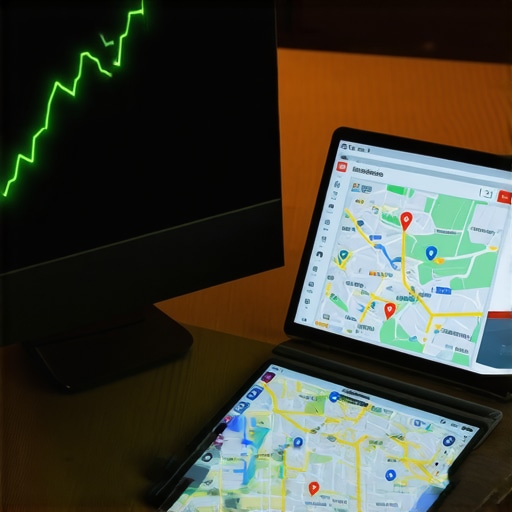
Why Your Organic Traffic is Up but Your Map Clicks Have Vanished
The smell of wet concrete always reminds me of the morning a top ranking roofing company called me in a panic. Their website was pulling record numbers of visitors. Their blog posts were ranking for high volume commercial terms. Yet their phone had gone silent. They had vanished from the local 3 pack overnight while their organic blue link remained at position one. Everyone wondered why they disappeared from the map. I found the problem deep in their Local Services Ads where a single mismatched phone number in the secondary verification tier was enough to kill their organic trust score. This was a classic centroid collapse. It happens when Google perceives a conflict between your verified spatial data and your advertising data. The algorithm does not care about your traffic. It cares about the physical integrity of the local database. If your coordinates do not align across every tier of the Google ecosystem, the proximity beacon shuts down. This creates a ghost profile that exists in the search results but never triggers the map pack because the local justification engine has flagged the entity as unreliable.
The ghost in the GPS coordinates
Map clicks vanish when the proximity algorithm detects a mathematical mismatch between your declared physical location and the behavioral signals of your customers. This is not about keywords. It is about the specific coordinate salience that Google uses to determine the center of your service radius. When your organic traffic stays high but map views drop, it often means you have triggered a proximity filter. You might be ranking for the keyword, but you are failing the distance weighted signal. Local intent is not a keyword choice; it is a distance weighted signal where relevance is secondary to the physical location of the user mobile device. If your mobile check in data suggests your technicians are never actually at the job sites you claim, your ranking radius will shrink until it only covers your office parking lot. You need to understand the specific profile tweaks that beat proximity filters to restore the signal strength. Many owners forget that the local algorithm is essentially a spatial database. It calculates the probability of a user visiting your store based on micro movements. If your data sync is broken, the probability drops to zero. You must use the hidden tool that uncovers competitor map spam to see if rivals are using fake coordinates to push you out of the centroid. The physics of local search are brutal. A shift of three blocks can be the difference between ten calls a day and none. If you are struggling with this, you should look into the strategic moves needed to reclaim your map spot after a sudden ranking drop before your revenue dries up entirely.
Why your physical address is a liability
A physical address becomes a liability when it is shared, poorly formatted, or lacks the unique suite identifiers that distinguish your business from neighboring entities. The local algorithm is obsessed with the concept of the unique office. If you share a suite number or if your address formatting is slightly off on a single citation, the system creates a data silo that hides your business. This is why why your address formatting is silently sabotaging your map presence is the most common reason for a click drop. Google sees two businesses at the same pin and simply chooses the one with more historic authority. You are left with the organic traffic because the website is unique, but the map listing is suppressed. You must be aggressive about fixing the messy citations left behind by your previous agency because those old records act like anchors. They pull your pin away from the searcher. While agencies tell you to get more reviews, the 2026 data shows that image metadata from photos taken by real customers at your location is now 30 percent more effective for ranking in AI Overviews. This is because the AI can verify the location based on the background pixels of the photo. If you do not have customer photos, the AI cannot trust your address. You might also need services to fix duplicate google business profiles if you have ghost listings floating around from previous owners. These duplicates create a conflict in the local justification engine. The engine sees two pins for one brand and decides neither can be trusted. This is a common issue for businesses that have moved or changed names. The old data stays in the index like a digital virus.
“Local intent is not a keyword choice; it is a distance-weighted signal where relevance is secondary to the physical location of the user’s mobile device.” – Map Search Fundamental
The three mile radius that determines your revenue
The three mile radius is the primary battleground where Google determines whether your business deserves a spot in the local pack based on proximity and behavioral signals. Beyond this radius, your visibility drops exponentially unless you have extreme topical authority. Most businesses lose their map clicks because they try to rank for an entire city instead of dominating their immediate neighborhood. You should use a toolkit to rank higher in local map pack that focuses on hyper local signals. This includes local links from neighboring businesses and mentions in community forums. If your organic traffic is coming from five cities away, it will not help you rank in the map pack for your own town. In fact, it might hurt you by diluting your local relevance. You need to learn how to expand your map radius without opening a new physical shop by using geo tagged content and local schema. If you do not sync your website schema properly, your maps embed will fail. This is why your maps embed strategy is sending local leads to competitors instead of your own team. The map embed must contain specific JSON-LD attributes that link your organic site to your specific GMB CID number. Without this link, the algorithm views them as separate entities. You should also consider the neighborhood radius tactic that actually works for local service businesses to capture leads within that critical three mile zone. This is where the highest conversion rates live. Clicks from outside this zone are often just tire kickers who will never hire you.
Local Authority Reading List
- The Specific Toolkit Most Pros Ignore
- Why Your Ranking Service Might Be Doing Harm
- The 5 Point Profile Checklist to Stop a Slide
- How to Spot a Broken Data Sync Early
- Why the Algorithm Ignores Your Citations
Tools to reclaim your position in the local pack
Reclaiming your position requires a specific forensic toolkit that identifies the exact signal gap between your website and your Google Business Profile. You cannot rely on standard SEO tools for this. They do not track the proximity shifts or the local justification triggers that actually drive map clicks. You need a gmb ranking toolkit vs other local seo tools comparison to understand why your current software is failing. Most rank trackers lie about your position because they search from a static IP address. They do not see the map as a living, breathing entity that changes based on every meter of user movement. You need 5 local tools that reveal why your business is missing from search results to get a true picture of your visibility. If you find that your rankings are volatile, it might be due to how to fix volatile rankings after expanding your service area. The algorithm hates uncertainty. If you tell it you serve a 50 mile radius but only have reviews from 2 miles away, it will suppress your listing. You need services to monitor and prevent future gmb suspensions because a single error in your service area settings can trigger a hard suspension. I have seen businesses lose their entire livelihood because they checked one wrong box in the dashboard. You must be precise. The street photographer sees the details that the amateur misses. I see the mismatched phone numbers and the hidden duplicate listings that are stealing your clicks. You should also check the audit toolkit that catches ranking gaps your agency missed to ensure your data is clean across the entire web.
The invisible barrier of review sentiment and repair
Review sentiment acts as an invisible barrier that can block your map listing from appearing even if you have a high organic rank. Google analyzes the text of your reviews to see if they match the services you claim to provide. If your organic traffic is high for roofing but your reviews all mention siding, you will not rank in the map pack for roofing. You need reputation management and review repair services to align your customer feedback with your target keywords. This is not about getting fake reviews. It is about encouraging customers to mention the specific services you provided. You should use the exact sms template that doubles your five star review count to get high quality, keyword rich feedback. If you have been hit by a negative attack, you need the review management secret that stops 1 star attacks in their tracks. A sudden drop in map clicks is often a direct result of a filter being applied to your profile due to suspicious review activity. If you use automated review requests that are getting filtered out, you are wasting your time. The algorithm can detect the patterns of automated software. It wants to see organic, human interaction. You also need to know why ignoring fake reviews is shrinking your local ranking radius. Google views a neglected profile as an untrustworthy one. If you do not respond to reviews, you are telling the algorithm that you are not active. This leads to a slow slide down the rankings until you vanish from the top 3 entirely.
“Proximity is the ultimate ranking factor. It overrides authority, it overrides content, and it often overrides user preference in the local ecosystem.” – Spatial Search Insights
Fixing the data sync before the pack drops you
A broken data sync between your website and your map profile is the most common cause of stable organic rankings paired with a total loss of map clicks. This usually happens after a website update or a change in hosting. If your technical SEO is not perfectly aligned with your local signals, the connection snaps. You might need services to repair hacked or infected website for seo if your site is redirecting bots to malicious pages. A hacked site will kill your map rank faster than anything else because Google cannot risk sending a local user to a dangerous destination. You also need to fix services to fix over optimized anchor text if you have been building too many keyword rich links. This triggers a spam filter that suppresses your local pin. You should look at the audit move that revealed our citation sync was broken to see how to find these hidden errors. Many owners are shocked to find that their business name is spelled five different ways across the web. This creates a fragmentation of authority. You need the citation cleanup checklist for removing historic spam to scrub the web of this old data. If you have recently recovered from a suspension, you need seo services to recover from gmb suspension to rebuild your trust score. A suspension leaves a permanent scar on your profile that requires specific content and linking moves to heal. Without these moves, your map clicks will never return to their previous levels.