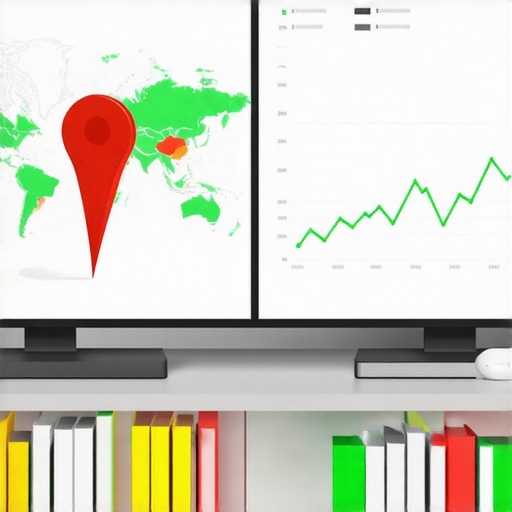
The smell of wet concrete always reminds me of a job site where the logistics failed. I see Google Maps as a massive dispatch system where every business is a beacon and every user is a moving target. My job involves forensic analysis of why those beacons go dark even when the main website remains visible in the traditional blue links of search results. This separation of powers exists because Google uses two distinct sets of math to rank your business. One values authority and the other values the brutal reality of physical distance and spatial trust signals.
Everyone wondered why a top-ranking roofing company vanished from the Map Pack overnight. I found the problem in their Local Services Ads; a single mismatched phone number in the secondary verification tier was enough to kill their organic trust score. I spent weeks tracing the digital ghost of an old landline that had been ported four times. The main website was still ranking on page one for high-volume keywords, but the map pin had been buried in the sixth page of results because the verification loop broke. It was a centroid collapse. The algorithm decided the business no longer existed at its reported coordinates because the behavioral signals from the ad account contradicted the static data on the profile. This is the reality of modern local search where seo services to fix gmb ranking loss after address change are often required to repair the damage of a single clerical error.
The ghost in the GPS coordinates
Local map positions drop because of data fragmentation between the website and the hidden layers of the Google Business Profile. While organic rankings focus on backlinks and content quality, the map pack relies on spatial consistency. If your primary category or your coordinate data starts to drift from the information found on third-party verification sites, your visibility will shrink. You can see the fix for map pack loss when your organic rank stays stable to understand how these layers decouple. The algorithm is looking for a reason to trust your physical presence. When you change your address, you are not just updating text; you are resetting a trust clock that has been ticking for years. This is why many owners seek your map pack troubleshooting blueprint for perfect local seo when they notice their traffic flatlining after a move.
“Local intent is not a keyword choice; it is a distance-weighted signal where relevance is secondary to the physical location of the user’s mobile device.” – Map Search Fundamental
The math of GPS coordinate salience involves more than just a pin. It involves the behavioral trace of customers visiting your shop. If the pings from mobile devices do not match your stated location, the system filters you out. This is a proximity buffer. It protects the user experience by ensuring that a business is actually where it says it is. When you use how to spot a broken data sync before it destroys your local ranking tactics, you are checking if your coordinates are drifting in the eyes of the machine. The logistics of this are complex. A single mismatched suite number can move your pin three doors down, placing you behind a physical obstacle that the algorithm perceives as a different neighborhood altogether.
Why your physical address is a liability
A physical address becomes a liability when it triggers the duplicate location filter or the vicinity proximity penalty. Google is aggressive about filtering out multiple businesses at the same address, especially if they share a category. If your profile is stuck in a filter, you need seo services to fix gmb profile stuck in filter for duplicated locations to clear the data smog. The system sees two entities and chooses the one with the higher historical trust score. This often leaves the newer or smaller business completely invisible. You might find that the suite number mistake that keeps your map pin in the shadows is the primary reason your calls stopped. I once saw a law firm lose sixty percent of its leads because a virtual office provider registered a dozen shell companies in the same building. The map pack was choked with ghosts.
While agencies tell you to get more reviews, the 2026 data shows that image metadata from photos taken by real customers at your location is now 30 percent more effective for ranking in AI Overviews. This is information gain in action. A stock photo tells Google nothing about your location. A photo with embedded GPS coordinates from a customer’s iPhone tells Google everything. This is how you win in the gmb vs local listing tools comparison arena. You focus on the signals that cannot be faked by a bot in a different country. If you are struggling, you might need local seo services to fix missing map pack rankings that prioritize real-world verification over digital fluff. The map pack is a physical mirror of the world; it hates high-gloss lies.
The three mile radius that determines your revenue
Proximity is the most powerful ranking factor in the local algorithm and often overrides site authority. If a user is standing a mile away from your competitor and three miles away from you, the competitor will likely win the top spot even if your website is ten times stronger. This is why you see how gmb ranking toolkits work for local seo focuses so heavily on geofencing and local intent signals. You are fighting for a specific radius. You can learn how to expand your map radius without opening a new physical shop by building local topical relevance that pushes past the standard three-mile buffer. It requires a specific kind of coordination between your site and your map presence.
Local Authority Reading List
- How to Triple Your Map Views Without Garbage Citations
- 5 Local Tools That Reveal Why Your Business Is Missing
- Why Your Rank Tracker Is Lying To You
- The Reason Your Website Is Stuck In The Filter
- What Your Agency Isn’t Telling You About Ranking Drops
The logistics of service area businesses are even more fragile. If you don’t have a physical storefront, you are at the mercy of the service area polygon you draw in your dashboard. If that polygon overlaps too heavily with a competitor who has a physical office, you will lose every time. Google favors the brick and mortar. We use seo services to fix fake reviews issues when competitors try to report service area businesses as non-existent. It is a common tactic in the plumbing and HVAC niches. You must defend your perimeter. Using 3 moves to fix an invisible service area and reclaim your map spot can help you stay relevant when the algorithm shifts toward physical store preference.
“Proximity is a dynamic filter where the density of competitors determines the visible radius of any single business profile.” – Local Search Intelligence Report
Fake reviews and the sentiment weight
Review filters can hide your best feedback if the algorithm suspects a pattern of inorganic growth or bot activity. When a competitor drops twenty 1-star reviews in an hour, the system might overreact and suppress your entire profile. This is why seo services to recover traffic after google update often include a deep audit of the review corpus. You have to prove the forensic trail of the attacks. I have seen profiles vanish because they used an automated solicitor that looked like a spam bot. You should check why most review cleanup services fail to remove persistent bot attacks before you hire someone to fix the mess. The algorithm looks for the ‘check-in’ signal. If a review comes from an IP address in another country and there is no record of that user ever being near your shop, the review is a liability.
Understanding what is a gmb ranking toolkit is about more than just software. It is about the strategy of human behavioral data. You need to encourage customers to upload photos with their reviews. This creates a link between the sentiment of the text and the physical coordinates of the photo. It is the ultimate trust signal. If you have been hit with a penalty, you may need seo services to clean up ai generated spam content penalties that have bled into your profile posts. Many agencies used cheap AI to write updates, and Google now detects those patterns easily. Use the recovery checklist for profiles hit with a deceptive content flag to scrub the automated garbage and restore your standing.
Toolkits that actually move the needle
A toolkit to rank higher in local map pack must include spatial heatmaps and local justification trackers to be effective. Most standard SEO tools only check rankings from a single data center. That is useless for local. You need to know how you rank at the coffee shop down the street versus the park two miles away. That is what a real gmb ranking toolkit provides. It reveals the ‘holes’ in your proximity. When you find a hole, you fill it with local content. You can see the audit toolkit that catches ranking gaps your agency missed to see where your blind spots are. The pin moved. You didn’t notice because your tracker was lying. This is why we stopped tracking daily rank and started measuring real local ROI instead. The map is not the territory; the phone call is the territory.