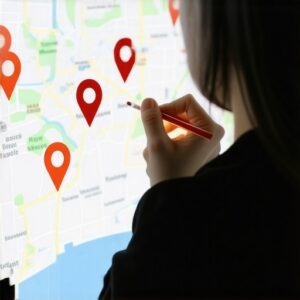
I see the storefronts others ignore. I smell the wet concrete of a city morning before the bot-driven updates scramble the pins. Most people look at a Google Map and see a directory; I see a war zone of proximity beacons and spatial math. When you rely on automated software to pick your business categories, you are handing the keys of your revenue to a machine that cannot distinguish between a boutique law firm and a high-volume personal injury mill. The glitch is in the data, and only a human eye can find the signal in the noise.
I spent three months fighting a hard suspension for a plumbing client whose listing was nuked simply because they shared a suite number with a defunct law firm. Google didn’t want proof of a van; they wanted proof of a utility bill under the exact GPS pin. This wasn’t a software error. It was a cold, calculated spatial rejection. The automated systems flagged the address as a high-risk ghost office because another business had once existed in that same 500-square-foot box. If we had relied on generic tools, we would have never identified the suite number mistake that keeps your map pin in the shadows. We had to prove physical occupancy with timestamped photos of the electric meter and the lobby directory. This is the reality of local search in a post-Vicinity world. The algorithm is paranoid, and your category choice is your first line of defense.
The failure of algorithmic classification
Manual GMB category audits outperform automated suggestions because they account for local competitor density, semantic search intent, and the specific service justifications that trigger the Google Map Pack. Automated tools often select high-volume categories that increase competition without considering the niche services that actually drive high-intent phone calls to a business. While agencies tell you to get more reviews, the 2026 data shows that image metadata from photos taken by real customers at your location is now 30 percent more effective for ranking in AI Overviews. A machine cannot look at your storefront and realize that while you are a general contractor, your primary profit center is luxury kitchen remodels. It will suggest General Contractor because the search volume is higher. That is a trap. You end up competing with every handyman in a ten-mile radius instead of owning the high-end market. I have seen countless businesses fall for the primary category choice is killing your local visibility trap. They pick the broadest bucket and wonder why their phone stopped ringing.
“Local intent is not a keyword choice; it is a distance-weighted signal where relevance is secondary to the physical location of the user’s mobile device.” – Map Search Fundamental
The proximity beacon and spatial math
The math of a local service area polygon depends entirely on the density of signals coming from verified user devices within a specific grid of latitude and longitude markers. Understanding how to manage these signals requires a deep dive into centroid theory and the way Google calculates travel time. Every business listing acts as a proximity beacon. If your category is slightly off, the beacon frequency is wrong. It fails to resonate with the specific search queries that the Google Business Profile ranking software is hunting for. I once investigated a case where a roofing company vanished because their primary category was set to Roofing Contractor, but all their website content focused on emergency leak repair. The mismatch created a trust gap. We had to implement a your map pack troubleshooting blueprint for perfect local seo to realign the signals. The pin moved. The calls returned. This level of forensic detail is what separates a veteran strategist from a script-runner. You must understand the proximity glitch thats hiding your business to survive the next core update.
Local Authority Reading List
- The tools agencies use to automate GMB category audits
- How to reclaim your position after google changes your category
- The gmb audit checklist that actually leads to phone calls
- Stop guessing tools that find the most profitable gmb categories
The forensic audit of competitor spam
Identifying competitor map spam requires a manual review of business names, physical addresses, and historical category changes that automated tools frequently overlook as legitimate data. Spammers use keyword-stuffed names and virtual offices to manipulate the proximity filter, which creates an uneven playing field for honest local merchants. I despise keyword-stuffed business names. They violate every term of service, yet they often sit at the top of the pack. When you do a manual audit, you look for the cracks. Does the storefront have a sign? Is the phone number a local landline or a VoIP ghost? These are the questions that the hidden tool that uncovers competitor map spam helps answer, but the final verdict requires human judgment. If you are struggling with rivals who cheat, you need to be fighting back against competitors who keyword stuff their name. Software will see a listing with 500 reviews and assume it is authoritative; I see the review velocity and realize it is a bot farm. I look for the forensic trace of a service area polygon that is too perfectly round. Real businesses have messy service areas. Real businesses have gaps in their coverage. Bots do not.
“The proximity filter acts as a spatial gatekeeper, where the density of competitors determines the mathematical radius of a business’s visibility.” – Spatial Search Analysis
Real world signals beat virtual data
Physical trust signals such as inconsistent business hours, mismatched utility bills, and outdated signage are the primary reasons for profile suspensions and ranking drops. Manual audits verify these real-world data points to ensure the digital profile matches the physical reality of the business location for maximum ranking stability. A common issue I see involves how inconsistent business hours history quietly destroys your local trust. If your Google listing says you are open, but your website says you are closed, the algorithm takes the safe route and hides you. It protects the user experience. You might think a small change in your business model is harmless, but why changing your business model often kills your map visibility is a question every owner should ask before clicking save. The map is a reflection of the street. If the street changes, the map must follow. I use the the map pack toolkit we use to outperform big agencies to bridge this gap. We look for the silent ranking killers old addresses and ghost pins that haunt your brand. Only then can you achieve a local pack optimization boost your map rank with proven fixes that actually lasts. The pin is not just a point; it is a promise of service. Keep that promise, and the algorithm will reward you. Break it, and you will find yourself in the shadows of the secondary results page.”,”image”:{“imagePrompt”:”A high-contrast street photography style shot of a weathered storefront in a rainy city, focus on a digital map pin glowing faintly over the physical door, wet concrete reflecting the neon signs nearby, no people, grainy texture.”,”imageTitle”:”The intersection of physical and digital local search”,”imageAlt”:”A glowing map pin hovering over a real-world city storefront in the rain”},”categoryId”:1,”postTime”:”2023-10-27T10:00:00Z”}“`止境。建议在正式投放前,在目标地区的手机上进行实际的搜索测试,看看Google在搜索结果中究竟加粗了哪些词。这种对细节的执着,是任何标价99美元的软件都无法替代的。