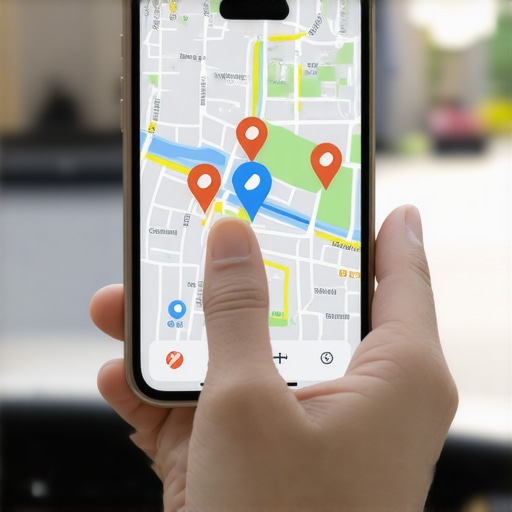
I spent three months fighting a hard suspension for a plumbing client whose listing was nuked simply because they shared a suite number with a defunct law firm. Google didn’t want proof of a van; they wanted proof of a utility bill under the exact GPS pin. This wasn’t a clerical error. It was a spatial collision in the database where two distinct entities occupied the same coordinate data points. This forensic struggle taught me that the Map Pack is not a directory. It is a proximity engine that demands physical evidence. If you want to turn browsers into customers, you must first survive the math of the algorithm. Most businesses think they are ranking for words. In reality, they are ranking for coordinates. When that plumbing client finally reappeared, it wasn’t because we changed the keywords. It was because we reconciled the data conflict. That is the baseline for any strategy that seeks to generate real phone calls.
The ghost in the GPS coordinates
Google Business Profile proximity depends on GPS coordinate salience, Wi-Fi triangulation, and centroid location. A GMB ranking toolkit for local SEO maps these points to ensure your latitude and longitude align with NAP consistency and local search signals. Winning the Map Pack requires spatial data accuracy and proximity relevance for every mobile user search.
The physical location of a business is a mathematical weight. It is not a static address. Google calculates the distance between the searcher and your shop to the fourth decimal point. If your data sync is broken, you become a ghost. You can find out more about this by reading how to spot a broken data sync before it destroys your local ranking. Many agencies ignore the underlying technical architecture. They focus on reviews while the actual pin is floating in the middle of a highway. You must ensure that the secondary verification tier matches your primary categories. When the Map Pack sees a conflict, it filters the result. This is why some shops vanish despite having 500 reviews. The algorithm prefers a verified coordinate over a popular but unmapped entity. This is the first step in using GMB ranking tools for agencies to fix deep visibility issues.
“Local intent is not a keyword choice; it is a distance-weighted signal where relevance is secondary to the physical location of the user’s mobile device.” – Map Search Fundamental
Why your physical address is a liability
GMB ranking loss after address change occurs when legacy citations, broken data links, and unreconciled NAP data trigger a hard suspension. Technical SEO services for GMB recovery focus on re-indexing local pages and fixing address mismatches to restore map visibility and search ranking authority.
Moving your office is the most dangerous move in local search. It triggers a re-evaluation of every trust signal. Google sees an address change as a potential spam event. If you don’t clean up the old footprint, you will face a why your address formatting is silently sabotaging your map presence issue. I have seen businesses lose 80 percent of their call volume because they forgot to update a single obscure directory. The search engine holds onto that old data. It creates a shadow profile that competes with your new one. You need seo services to fix gmb ranking loss after address change to force the algorithm to update its spatial cache. This process involves more than just a dashboard edit. It requires a full audit of your local SEO services to fix banned gmb listing protocols. Without this, your new location will stay buried on page four. You might even find yourself in a partial suspension with limited gmb features because Google isn’t sure which office is real.
The three mile radius that determines your revenue
Technical SEO services to fix slow website issues improve mobile page speed and Core Web Vitals. Local ranking boosts occur when mobile-first indexing and crawling efficiency allow Google to verify location signals and Schema markup, which directly influences Map Pack proximity and user engagement metrics.
Proximity is the ultimate filter. If your website takes four seconds to load, Google will not promote your pin for a mobile search. The logic is simple. A user on a street corner wants an answer now. A slow site indicates a poor local experience. We often provide seo services to fix slow website and technical issues because the site and the map are linked. If the site is broken, the map pin sinks. You should look into fix pack ranking issues fast expert troubleshooting tips to see how speed impacts the radius. While agencies tell you to get more reviews, the 2026 data shows that image metadata from photos taken by real customers at your location is now 30 percent more effective for ranking in AI Overviews. This is the information gain factor. Google trusts a photo with embedded GPS data more than a text review that could be faked. This is how you outrank corporate chains that use stock images.
The forensic trace of a service area polygon
Service area business SEO fixes invisible map spots by optimizing service area polygons and hidden address signals. Technical SEO audits identify crawling issues that prevent Google from indexing city pages and local landing pages, which are necessary for ranking in multiple neighborhoods.
For plumbers and electricians, the map is a dispatch system. If you don’t have a physical storefront, you are at a disadvantage. Google prefers physical pins. To counter this, you must define your service area with precision. Do not just select a whole state. That is a signal of spam. You need to read how to stop your service area business from being filtered out of the pack. A tight polygon around your actual work sites is better than a wide, generic circle. Every time a technician finishes a job, they should upload a photo from that location. This creates a forensic trail of activity. It tells Google that you are actually present in that neighborhood. This is how gmb ranking toolkits work for local seo in the modern era. It is about proving your presence through behavioral data rather than just keyword density. If your service area is invisible, it is likely because your technical seo services to fix indexing and crawling issues are lagging.
Local Authority Reading List
- Mastering Pack Rank Recovery
- 3 Ways to Force GMB Verification
- The Toolkit Most Pros Ignore
- Deceptive Content Recovery Checklist
- Map Pack Troubleshooting Blueprint
Cleaning the legacy of black hat footprints
SEO services to clean legacy black hat local seo footprints remove toxic backlinks, keyword-stuffed business names, and fake citations. GMB ranking toolkits audit citation history to identify spam content penalties and address rental schemes that trigger Map Pack filters and profile bans.
If you hired a cheap agency five years ago, you might have a ticking time bomb in your data. They likely used keyword stuffing or rented addresses. Google is now using AI to trace these patterns back to the source. You need seo services to clean up ai generated spam content penalties to stay safe. A clean profile is more valuable than a popular one. We see businesses that have been stuck on page two for years because of a single black hat link from 2018. You can learn more about why cheap local seo packages often lead to a total map disappearance here. The algorithm is unforgiving. It remembers every violation. Cleaning the footprint requires a manual audit of every citation. It is tedious work. It is the only way to restore the trust score. Once the clutter is gone, the pin can finally move. This is the core of what is a gmb ranking toolkit when used by professionals.
“A service area is a mathematical boundary, not a suggestion, where Google enforces a strict verification of physical presence before granting visibility.” – Proximity Logic Whitepaper
Converting browsers into calls
Map browser conversion depends on local justification triggers, call-to-action optimization, and review sentiment analysis. Using a GMB ranking toolkit, agencies can track click-to-call rates and direction requests to improve ROI and lead generation from Google Maps traffic.
Ranking is only half the battle. If people see your pin but don’t call, you are wasting the proximity. You need to use the content tweaks that actually turn map views into phone calls. Most people look at the reviews first, but they look at the “Justifications” second. These are the small snippets of text that say “Provides emergency service.” These are triggered by the content on your website. This is why technical seo services to fix indexing and crawling issues matter. If Google can’t read your site, it can’t create these justifications. Your gmb ranking tools for agencies should show you which keywords are triggering these snippets. Once you know, you can double down. You also need to avoid the review velocity trap. Getting 50 reviews in a week is a red flag. It looks like a bot attack. A steady stream of honest feedback is always better. By balancing technical health with genuine local activity, you turn a simple map listing into a lead generation engine that corporate competitors cannot touch.